A cyber risk assessment is a five-step process that involves meticulously identifying and securing your IT and digital infrastructure against potential threats. This includes:
Curating IT and Digital Assets:
As organisations adopt more technology, assessing all IT assets can be complex. To address this, risk assessments can focus on specific areas like a business unit, location, or department.
Detecting Threats and Vulnerabilities:
This involves identifying suspicious files, unauthorised access attempts, and other unusual activities that could compromise your network security.
Analysing the Risks:
Once you’ve identified threats and vulnerabilities, you need to analyse the associated risks. This involves assessing how likely these vulnerabilities are to be exploited and the potential severity of the impact.
Prioritising Risks:
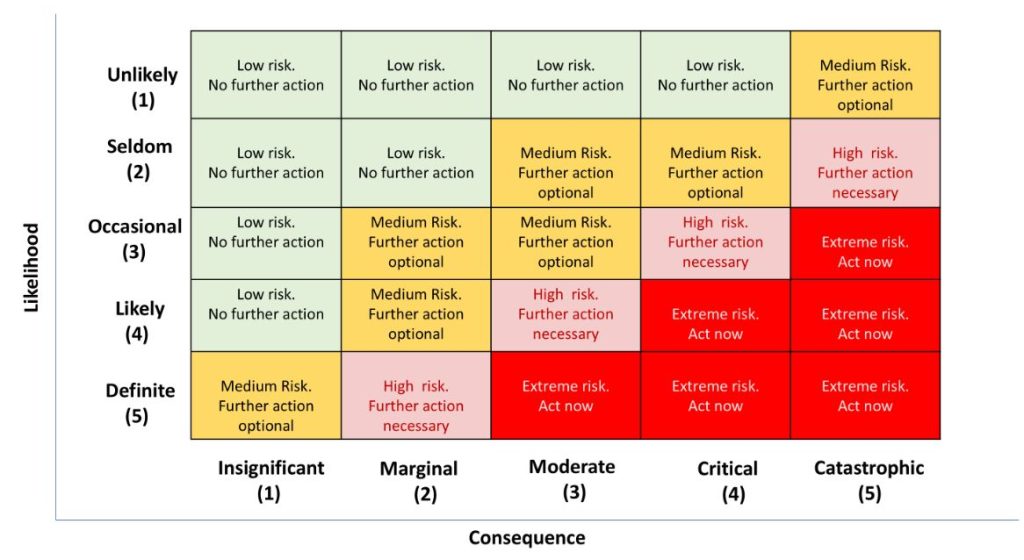
Prioritising risks based on likelihood of exploitation and potential impact helps you understand your organisation’s overall risk landscape. Tools like a 5×5 risk matrix or a 0-100 grading system can be helpful for this.
Developing a Risk Catalogue:
A risk catalogue tracks security goals, detailing scenarios, dates, controls, and risk levels, with regular reviews for updates and adjustments.
Cyber Security Risk Assessment Matrix
The 5×5 risk assessment matrix has five rows and columns. The columns represent the severity of the risk, and the rows represent the likelihood of it occurring. This creates a grid with 25 cells where risks can be categorised based on their likelihood and severity, ranging from “unlikely and not severe” to “highly likely and severe”.
Cyber Risk Assessment Frameworks
A cyber risk assessment framework outlines an organisation’s approach to identifying, assessing, and managing risks to their IT and digital infrastructure. Organisations can choose to develop their own framework or adopt industry standards like:
Factor Analysis of Information Risk (FAIR): A quantitative framework for measuring, managing, and communicating information risk.
OCTAVE (Operationally Critical Threat, Asset, and Vulnerability Evaluation): Defines a risk-based strategic assessment technique for security.
Threat Agent Risk Assessment (TARA): Identifies, assesses, prioritises, and controls cybersecurity risk based on threats.